
OUR CAMPUS
Our preschool campus reflects the key values from which we build our program. We have designed child-centered, home-like environments which prompt experimentation, encourage flexible thinking, and invite connection. With access to natural elements that ignite our senses, we strive to promote the appreciation of aesthetics and the beauty of intentionally presented materials. Through these practices, St. Michael's demonstrates our trust in children's abilities to be agents of their own learning

Classrooms
At St. Michael's Day School, we create dynamic classroom environments that inspire young minds and encourage exploration. Our thoughtfully curated materials nurture a love for learning, while each space sparks curiosity and creativity. Students engage in diverse activities promoting cognitive, emotional, and physical growth. Our classrooms offer resources for emergent curriculum and hands-on learning, including literacy materials, dynamic play centers, and tools for science, math, and art exploration. We value each child's uniqueness, crafting adaptable environments that cater to individual interests. Our goal is to make learning come alive, fostering wonder and curiosity in a lifelong journey of discovery


Infants & Young Toddlers
Toddlers
Young Twos
Older Twos & Younger Threes
Older Threes
Pre-K 4-5s
Encounters with the
Hundred Languages
The atelier invites encounters with materials, the languages for expression. Consistent revisiting of these materials develops what is called an “appreciative background” from which children can form deeper knowledge and meaning. The Hundred Languages exist in this space as an invitation to express ideas in multiple forms.
Reflective and Relational
As children develop relationships with materials in the atelier, they in turn develop relationships with the other contributors of the space: their peers and the adults. The atelier becomes a system of interconnected relations, with children and adults exchanging ideas and beliefs,and thus coming to know each other, and themselves, more intimately.
Meaningful Research
Children uncover hidden potentials of materials and use them to represent new ideas. Adults carefully observe and document these occurances in order to better understand children’s thinking.

The Culture of the Atelier
“The atelier serves two functions. First, it is a space that makes it possible for children to encounter interesting and attractive contexts, where they can explore many and diverse materials as well as techniques... Second, it assists the adults in understanding processes of how children learn.” -Vea Vecchi, Reggio Emilia Atelierista
Outdoor Spaces
At St. Michael’s, our students spend a large portion of their day outside. We value the experiences that only nature can offer to young children. Whether they are engrossed in new discoveries in our outdoor classroom, hiking our nature trails, or building an obstacle course in our nature playground, children can be observed exploring the outdoors in every season.

Playgrounds
We offer age-appropriate playgrounds to meet the needs of all of our children. Our younger classrooms utilize a playground equipped with a climbing structure and slides, a double-ended water table, a mud kitchen, and many vehicles and tools for transporting materials around the space. Our older classrooms have access to another playground which features a climbing structure with rock wall and pulley system features, a sandbox enclosed within a wooden ship, sensory tables and easels, as well as a large bike path.

Mud Kitchen
Our nature playground allows children the opportunity to utilize natural materials to redesign their environment. This space encourages children to take calculated risks and fine-tune their motor skills through jumping, climbing, and balancing on a range of materials. Some of these motor-specific materials include a rope swing, circle swing, elevated rope tunnel, and large wooden stumps, planks, and boxes for constructing

Nature Playground
This space acts as a living embodiment of our educational philosophy, providing ample opportunities for our children to immerse themselves in the natural world, complete with a fillable dry creek, a large mud kitchen, sensory garden, music wall, and shaded pavilion for focused research.

Nature Trails
Our campus boasts direct access to miles and miles of nature trails. Classrooms can be found exploring different stretches of the trails, collecting natural items, searching for signs of wildlife, and observing the changing of the seasons.

Language & Literacy
Within a Reggio-inspired approach, literacy is understood as more than learning to read and write. In the spirit of the Hundred Languages, children communicate, represent, and construct meaning through many expressive forms, including drawing, movement, dramatic play, music, construction, visual arts, and spoken and written language. Early literacy is supported through daily read-alouds, rich conversations, storytelling, and meaningful encounters with print in authentic contexts. Children explore letters and sounds through environmental print, shared writing experiences, documentation, and meaningful opportunities to use print for real purposes. They may create signs or labels for their work, make books, record ideas, write messages to classmates or loved ones, or use drawing and invented spelling to make their thinking visible. Educators observe and respond to each child's developing ways of communicating while also providing individualized opportunities to strengthen phonological awareness and early reading and writing skills.
Why is our library so special?
Our library is a space that prioritizes the development of literacy and language skills as well as self-regulation.
Literacy and Language Skills:

Books
Open-Ended Learning: Language & Literacy
When visiting the library children are welcome to browse the shelves and choose books that captivate their interest. This type of open-ended invitation encourages children to explore and allows them to make new discoveries. By limiting adult instruction during this time, children are able to derive their own meaning from the books, rather than being told how they should interpret them, giving the children autonomy and encouraging imaginative thinking.
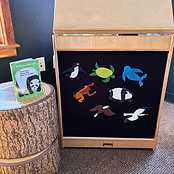
Felt Board
Focused Learning: Language
At the felt board, a book is set up with accompanying felt pieces. The children are invited to follow along or re-tell the story using these materials, building sequencing and narrative skills. This also encourages children to discuss the events of the story with each other, deepening their comprehension as they gain additional knowledge and new perspectives.

Letter Boxes
Focused Learning: Literacy
For each letter of the alphabet we have a box that contains items that begin with that letter. Children are invited to identify an item and practice sounding it out, developing phonological awareness. By engaging with letter sounds in an interactive and hands-on way, children gain confidence in their ability to identify letters. As self-assurance increases, children become even more motivated to learn.

Self-Regulation
A Life-Long Skill
Self-regulation is the ability to understand and manage your own emotions, reactions, and behaviors. The ability to self-regulate is a necessary building block for daily functioning and learning. When a child is dysregulated, they often have trouble focusing and may have difficulty interacting with peers. Developing the skill of self-regulation begins with co-regulation. Co-regulation is when an adult is able to help a child return to a place of emotional equilibrium. In practice, co-regulation might look like a hug, reading a book together, or simply serving as a soothing presence.
Our library space was intentionally structured to promote emotional regulation.
With several windows looking out onto the Greenbelt, natural light illuminates the library and the children have views of trees and greenery. The walls are painted dark blue with bright yellow stars, creating a cozy atmosphere that promotes tranquility. This space was designed to be used by small groups, so that children can have a calming and comforting environment to engage in co-regulation. By curating an environment that cultivates a peaceful energy, children are able to successfully co-regulate with their teachers and learn self-regulation techniques that they can apply in other situations.
By creating the scaffolding for self-regulation in early childhood, children are building a foundational skill that will serve them well for life.